Calculate the sign of zodiac of a date.
Arguments
- x
the date to transform, a
Dateor anything thatmonth()andday()accept- lang
language of the zodiac names:
"en"(English),"de"(German) or"local", which gives the German names in a German locale and the English ones everywhere else. Falls back to the"lang"option (options(DescToolsX.lang = )) as inmonth()andweekday(), and to"local"if the option is not set.- stringsAsFactors
logical. If set to
TRUE(default) the result will consist of a factor with zodiac signs as levels.
Details
The really relevant things can sometimes hardly be found. You just discovered such a function... ;-)
The following rule to determine zodiac symbols is implemented:
Dec. 22 - Jan. 19 : Capricorn | Jan. 20 - Feb. 17 : Aquarius |
Feb. 18 - Mar. 19 : Pisces | March 20 - April 19 : Aries | April 20 - May 19 :
Taurus | May 20 - June 20 : Gemini | June 21 - July 21 : Cancer | July 22 - Aug.
22 : Leo | Aug 23 - Sept. 21 : Virgo | Sept. 22 - Oct. 22 : Libra | Oct. 23 -
Nov. 21 : Scorpio | Nov. 22 - Dec. 21 : Sagittarius
The boundaries are fixed calendar dates; the astronomical dates of the sun's entry into a sign shift by up to a day from year to year.
See also
Other date.time:
addMonths(),
countWorkDays(),
date-time-predicates,
date_functions,
generation(),
time-conversions
Examples
zodiac(as.Date(c("1937-07-28", "1936-06-01", "1966-02-25",
                 "1964-11-17", "1972-04-25")), lang="de")
#> [1] Loewe     Zwillinge Fische    Skorpion  Stier
#> 12 Levels: Steinbock Wassermann Fische Widder Stier Zwillinge Krebs ... Schuetze

# the boundary days
zodiac(as.Date(c("2015-01-19", "2015-01-20", "2015-12-21", "2015-12-22")))
#> [1] Capricorn   Aquarius    Sagittarius Capricorn
#> 12 Levels: Capricorn Aquarius Pisces Aries Taurus Gemini Cancer Leo ... Sagittarius

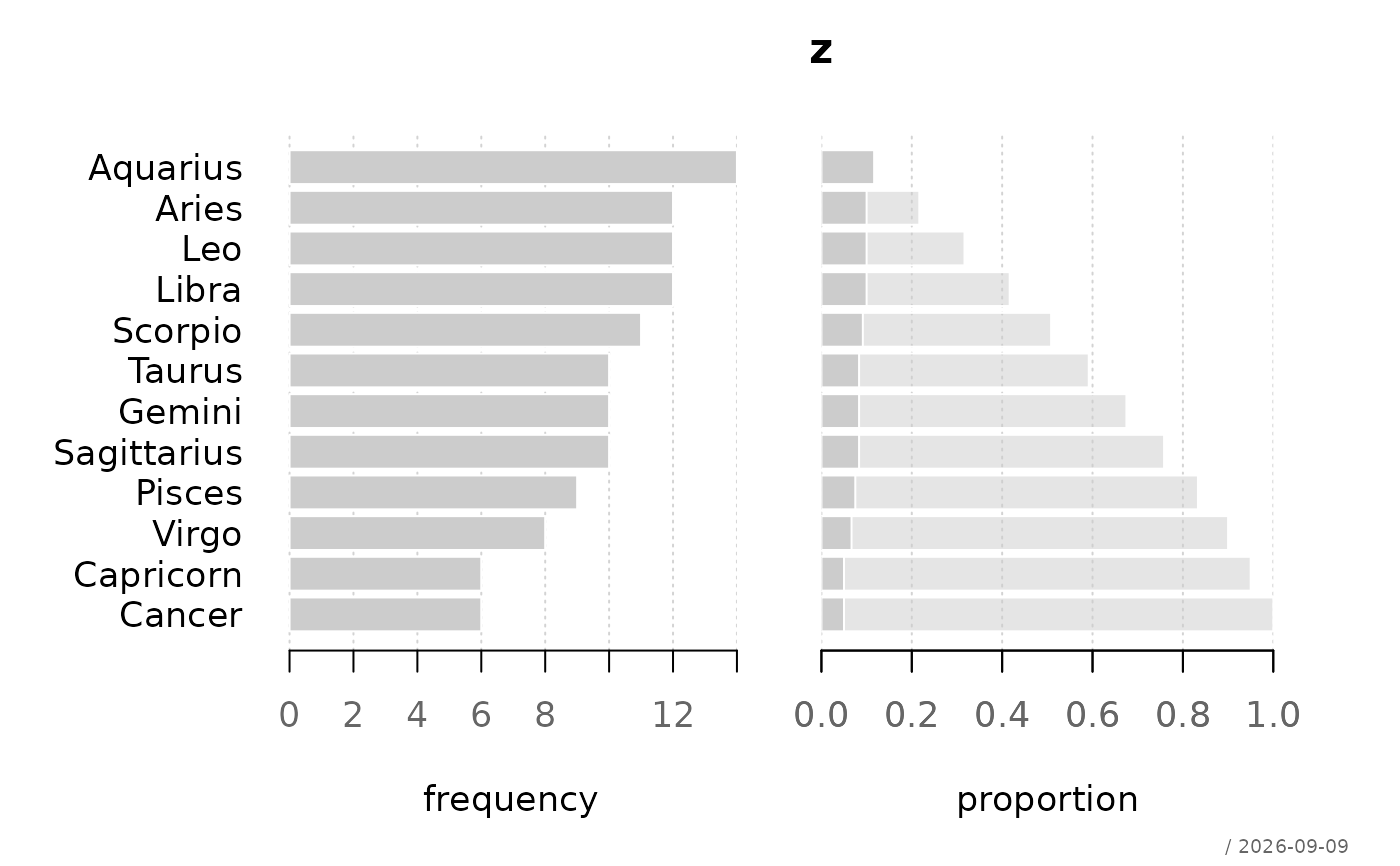
set.seed(1)
d <- sample(seq(as.Date("2015-01-01"), as.Date("2015-12-31"), 1), 120)
z <- zodiac(d)
desc(z)
#> ──────────────────────────────────────────────────────────────────────────────
#> z (factor)
#>
#>   length      n    NAs unique levels  dupes
#>      120    120      0     12     12      y
#>          100.0%   0.0%
#>
#>           level  freq   perc  cumfreq  cumperc
#> 1      Aquarius    14  11.7%       14    11.7%
#> 2         Aries    12  10.0%       26    21.7%
#> 3           Leo    12  10.0%       38    31.7%
#> 4         Libra    12  10.0%       50    41.7%
#> 5       Scorpio    11   9.2%       61    50.8%
#> 6        Taurus    10   8.3%       71    59.2%
#> 7        Gemini    10   8.3%       81    67.5%
#> 8   Sagittarius    10   8.3%       91    75.8%
#> 9        Pisces     9   7.5%      100    83.3%
#> 10        Virgo     8   6.7%      108    90.0%
#> 11    Capricorn     6   5.0%      114    95.0%
#> 12       Cancer     6   5.0%      120   100.0%
#>